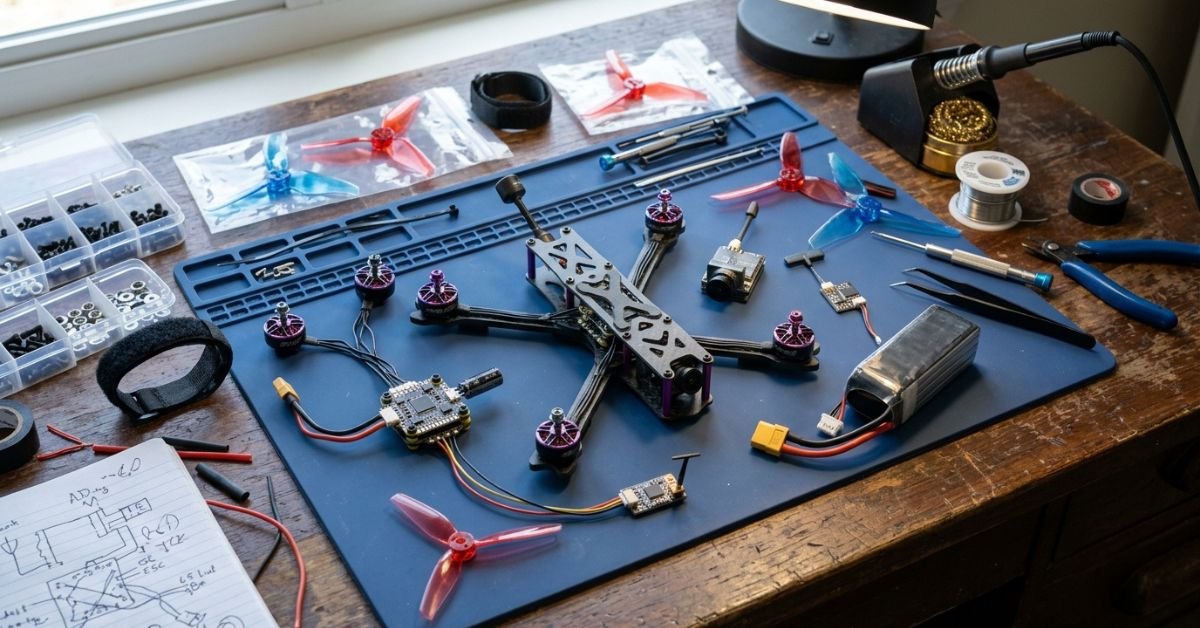
Building an FPV drone is one of the most rewarding parts of the hobby. Instead of buying a complete aircraft and accepting its factory configuration, pilots can choose individual components and create a drone that matches their preferred flying style.
The challenge is that an FPV quad is not made from one or two components. Motors, propellers, ESCs, flight controllers, batteries, receivers, video systems, and other hardware all need to work together. Choosing excellent individual components does not guarantee a good drone if those components are incompatible.
Whether you are building your first quad, repairing a crashed drone, or upgrading an existing setup, understanding the role of each component is the best place to start.
What Are the Main FPV Drone Parts?
A typical FPV drone can be divided into several systems:
- Frame and mechanical components
- Motors and propellers
- ESC and power system
- Flight controller
- Radio receiver and controller
- FPV camera and video transmitter
- FPV goggles
- Battery and charger
- Accessories and safety equipment
Each drone parts has a different purpose, but they are closely connected. The frame determines the available space and propeller size, the motors provide thrust, the ESC controls motor speed, and the flight controller coordinates the aircraft’s movement.
The battery supplies energy to the system, while the receiver and radio controller allow the pilot to control the aircraft. At the same time, the camera and video transmitter send the live view to the pilot’s goggles.
Understanding these relationships is much more useful than simply memorizing a list of components.
Start With the Frame
The frame is the physical foundation of an FPV drone.
Frames are commonly described by propeller size, such as 3-inch, 5-inch, or 7-inch. A 5-inch frame, for example, is designed around 5-inch propellers and is one of the most common platforms for freestyle and racing.
Frame size influences almost every other component.
A larger frame can accommodate larger propellers and motors, while a smaller frame requires compact and lightweight electronics. The frame also determines the mounting space available for the flight controller and ESC.
Before buying other components, consider the frame size, motor mounting pattern, stack mounting pattern, battery position, camera compatibility, and available internal space.
Starting with the frame gives you a clear foundation for selecting the rest of the build.
Motors: The Source of Thrust
Motors convert electrical energy into mechanical rotation, spinning the propellers and generating thrust.
When comparing FPV motors, you will commonly see specifications such as 2207, 2306, 2407, or 2806.5. These numbers describe the approximate stator dimensions and help indicate the motor’s physical size and torque characteristics.
KV is another major specification. It represents the motor’s approximate RPM per volt under no-load conditions.
However, a higher KV motor is not automatically better.
Motor KV needs to match battery voltage and propeller characteristics. A high-KV motor designed for a 4S setup may not be appropriate for a 6S configuration.
The motor, propeller, battery, and ESC should therefore be treated as one power system.
For a new build, comparing drone parts as a complete system can help avoid the common mistake of choosing each component independently.
Propellers Affect How the Drone Flies
Propellers may be inexpensive compared with electronics, but they have a major influence on flight characteristics.
Important propeller specifications include:
- Diameter
- Pitch
- Number of blades
- Weight
- Material
- Hub dimensions
A higher-pitch propeller can provide strong acceleration and speed but may place a greater load on the motor. Lower-pitch propellers can offer a different balance of responsiveness and efficiency.
Three-blade propellers are particularly common in modern FPV builds because they can provide a smooth and responsive feel.
Propeller selection should always be considered alongside motor KV, battery voltage, and drone weight.
ESC: Connecting Power to the Motors
The electronic speed controller, or ESC, controls the speed of the brushless motors.
Modern FPV quads frequently use a 4-in-1 ESC, which combines four motor-control circuits onto one board. This simplifies installation and reduces the amount of wiring inside the frame.
When selecting an ESC, pay attention to:
- Supported battery voltage
- Current rating
- Mounting pattern
- Motor protocol support
- Firmware
- Telemetry capabilities
- Cooling requirements
The ESC should have enough current capacity to handle the motor and propeller combination with an appropriate safety margin.
A powerful motor paired with an undersized ESC can create excessive heat and reliability problems, especially during aggressive flying.
The Flight Controller Is the Brain
The flight controller processes information from the onboard gyro and the pilot’s commands, then tells the ESCs how to adjust motor speeds.
It is one of the most important electronic components in an FPV drone.
When choosing a flight controller, look beyond the processor. Consider the mounting pattern, firmware support, UART availability, voltage compatibility, and connections for your receiver and video system.
A simple freestyle build may not need many additional ports, while a long-range drone with GPS and other peripherals may require considerably more connectivity.
The best flight controller is the one that fits the requirements of the build rather than simply having the most features.
Battery: Balancing Power and Weight
The battery determines how much energy is available to the drone and has a major influence on weight.
FPV batteries are often LiPo packs described by cell count, such as 4S or 6S, and capacity, such as 1100mAh, 1300mAh, or 1500mAh.
Higher capacity can provide more energy, but it also increases weight. A heavier battery requires more thrust to keep the drone in the air.
This creates a trade-off.
Racing pilots often prioritize lighter batteries for acceleration and agility. Freestyle pilots usually look for a balance between punch and flight time, while long-range pilots may accept additional weight in exchange for greater energy capacity.
Battery voltage must also match the motor and ESC specifications.
Radio Receiver and Controller
The radio system provides the communication link between the pilot and the drone.
The transmitter sends commands, while the receiver installed on the drone receives those commands and passes them to the flight controller.
ExpressLRS, commonly known as ELRS, has become a popular choice for modern FPV builds, but the important consideration is compatibility.
The transmitter and receiver must use a compatible protocol and configuration.
When choosing a radio system, also consider controller ergonomics, gimbal quality, switch layout, battery life, and portability. A comfortable controller can make a noticeable difference during long flying sessions.
FPV Camera and Video System
The video system allows the pilot to see what the drone sees.
A typical FPV video system includes:
Camera → Video Transmitter → Antenna → Goggles
The camera captures the image, while the video transmitter sends the signal to the goggles.
Pilots can choose between analog and digital video systems. Analog remains attractive for its simplicity and low hardware requirements, while digital systems generally provide significantly higher image quality.
The important point is compatibility. The camera, video transmitter, antennas, and goggles need to work together as part of the same video ecosystem.
FPV Goggles
FPV goggles display the live video feed to the pilot.
When choosing goggles, consider resolution, field of view, latency, comfort, weight, IPD adjustment, antenna configuration, and compatibility with the chosen video system.
Racing pilots may prioritize low latency, while cinematic pilots may place greater emphasis on image quality and immersion.
Comfort should not be overlooked. A technically impressive pair of goggles can still be frustrating if they are uncomfortable to wear during a long flight.
Battery Charger
A suitable charger is essential when using LiPo batteries.
A good FPV charger should support the battery chemistry and cell count you use and should provide balance charging for multi-cell packs. Storage mode can also be useful because it allows batteries to be brought to an appropriate storage voltage when they will not be used for an extended period.
Charging current and power output are also worth considering, particularly if you regularly fly with multiple batteries.
Safety should always come before charging speed. Damaged or swollen batteries should not be charged, and LiPo charging should be performed using appropriate equipment and safe charging practices.
Accessories Are More Important Than They Look
Some components do not directly make the drone fly, but they can make building, repairing, and maintaining an FPV quad much easier.
Useful accessories can include:
- Battery straps
- Spare propellers
- Capacitors
- Buzzers
- GPS modules
- Antennas
- Connectors
- Soldering equipment
- Tools
- LiPo safety bags
A few inexpensive spare parts can save an entire flying session after a crash.
For example, carrying spare propellers and battery straps is a simple way to reduce downtime during outdoor flying.
How to Make Sure FPV Parts Are Compatible
Compatibility is the most important consideration when buying components.
Before ordering, check:
Frame size: Does the component physically fit?
Battery voltage: Can the motors, ESC, and electronics handle the selected battery?
Motor and propeller: Are the motor KV and propeller appropriate for each other?
ESC current rating: Can the ESC safely handle the expected motor current?
Mounting pattern: Does the flight controller or ESC match the frame?
Radio protocol: Is the receiver compatible with the transmitter?
Video system: Can the goggles receive the video transmitter’s signal?
Connectors: Are the power and signal connectors compatible?
Components from different brands can work perfectly well together. Brand matching is not a substitute for checking technical specifications.
Buying FPV Parts for a New Build
For beginners, buying components in a logical order can make the process easier.
Start with the frame and determine the intended propeller size. Then select motors that match the frame, battery voltage, and flying style.
From there, choose an ESC that can handle the motors and propellers. Select a compatible flight controller with enough ports for your receiver and video system.
Finally, choose the battery, radio system, and video equipment.
This approach is more reliable than browsing individual products and buying whichever component looks most powerful.
MEPSKING is one example of an FPV-focused retailer where pilots can compare motors, ESCs, flight controllers, batteries, radio equipment, goggles, propellers, chargers, and accessories in one place. Its broad selection makes it possible to evaluate related components together when planning a new build or replacing damaged equipment.
New Build vs. Repair vs. Upgrade
Not every pilot needs to purchase a complete set of components.
If you are repairing a crashed drone, replacing a damaged motor with the same model and KV is often the simplest solution. For an ESC or flight controller, check mounting dimensions, connectors, voltage ratings, and firmware compatibility before ordering a replacement.
For an upgrade, identify what currently limits the drone.
If the drone feels underpowered, investigate the motor and propeller combination. If flight time is poor, consider battery capacity and overall weight. If the control system is unreliable, evaluate the receiver and radio system.
Upgrading one component without considering the rest of the system can sometimes create new compatibility problems.
Final Thoughts
Building an FPV drone is ultimately an exercise in system design. The frame, motors, propellers, ESC, flight controller, battery, radio system, and video equipment all influence one another.
The best approach is to start with your intended flying style and drone size, then select compatible components around those requirements.
For racing, low weight and rapid response may be the priority. Freestyle builds often balance power, durability, and control. Long-range drones emphasize efficiency and reliable communication, while cinematic builds may prioritize smooth flight and video quality.
You do not need the most expensive FPV components to build a capable drone. You need components that work together.
Once you understand how each part contributes to the complete system, choosing, repairing, and upgrading FPV equipment becomes much easier—and the process of building a drone becomes just as rewarding as flying it.