Building a chatbot with a large language model is relatively straightforward for developers familiar with APIs. However, making that chatbot answer questions accurately using company documents, technical manuals, or internal knowledge bases introduces a different set of challenges.
The application must retrieve relevant information, distinguish useful context from irrelevant content, and generate responses supported by reliable sources. Developers also need to consider performance, security, and how the system behaves when information is missing or outdated.
Retrieval-augmented generation (RAG) helps connect language models with external knowledge, but building dependable applications requires more than understanding the concept. For developers interested in this area, knowing which technical skills to develop and what practical training to look for is an important starting point.
Why RAG Skills Matter for Modern Software Developers
Software applications increasingly use natural language interfaces to help people access information. Customer support platforms, enterprise search systems, and technical documentation assistants are examples of where retrieval-based AI can be useful.
A conventional chatbot relies primarily on information available to its language model and whatever context is included in the prompt. RAG extends this approach by retrieving relevant information from external sources before generating an answer.
Consider a software company with hundreds of internal API documents. Instead of searching through individual files, developers could build an assistant that retrieves relevant documentation and explains how a particular API works.
This approach can improve the relevance of generated responses and make source verification possible.
However, RAG does not automatically prevent inaccurate answers. Developers must understand how information is retrieved, evaluated, and incorporated into the final response.
What Technical Skills Do Developers Need to Build RAG Applications?
Developers familiar with Python, APIs, and databases already possess useful foundations for RAG development. The additional challenge involves understanding how language models interact with retrieval systems.
Programming, APIs, and LLM Fundamentals
Python is widely used for building AI applications because it supports document processing, API integration, and machine learning libraries.
Developers should understand how to interact with LLM APIs, manage context windows, structure prompts, and handle model responses.
Knowledge of error handling and application testing is equally important when integrating AI functionality into existing software.
Embeddings, Vector Databases, and Retrieval
RAG introduces concepts such as document chunking, embeddings, semantic search, and vector databases.
Embeddings represent information numerically, allowing retrieval systems to identify content with related meanings. Vector databases can support efficient similarity searches across large document collections.
| Technical Area | Practical Capability |
| Python and APIs | Connecting language models with applications |
| Document processing | Preparing and organizing source information |
| Embeddings | Representing text for semantic retrieval |
| Vector databases | Searching relevant document collections |
| Prompt engineering | Incorporating retrieved information into responses |
| Evaluation | Assessing retrieval quality and answer reliability |
Understanding these components helps developers build applications that do more than generate plausible text.
How RAG Applications Work From Document Retrieval to Response Generation
A typical RAG application begins by preparing the information that users will eventually search.
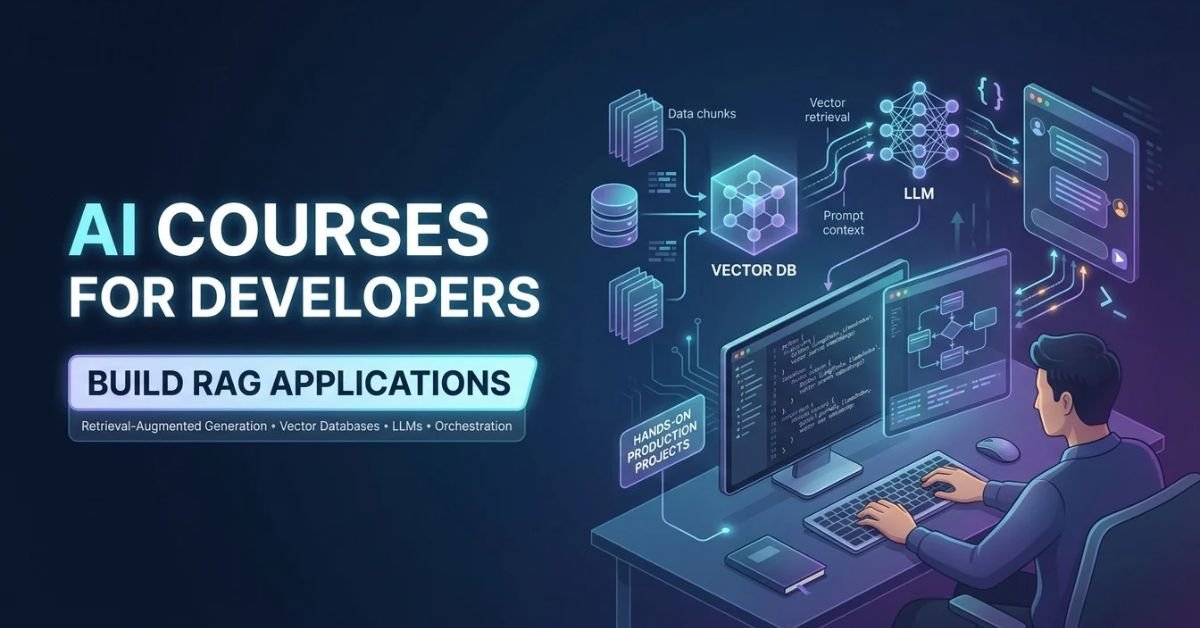
Documents are collected, cleaned, and divided into smaller sections. These sections are converted into embeddings and stored in a searchable index.
When someone submits a question, the application searches for relevant information and provides the retrieved passages to a language model.
The model then uses that context to generate a response.
Consider an internal technical documentation assistant. A developer asks how to authenticate requests to a particular service. The system retrieves the relevant API documentation and uses those passages to explain the authentication process.
The quality of the answer depends partly on how accurately the system identifies relevant information.
Poor document organization, inappropriate chunk sizes, or incomplete retrieval can affect the result even when the language model itself is capable.
This is why understanding the entire retrieval workflow matters more than connecting a model to a database.
Why Retrieval Quality and LLM Evaluation Matter
A RAG application can appear functional during a demonstration while producing unreliable answers under different conditions.
For example, a customer support assistant might retrieve an outdated refund policy and generate a response that no longer reflects company procedures.
The answer may sound convincing, but its supporting information is incorrect.
Developers need to evaluate both retrieval quality and response generation.
Retrieval evaluation examines whether the system finds relevant information. Response evaluation considers whether the generated answer is accurate, relevant, and supported by the retrieved material.
Concepts such as groundedness and faithfulness help assess whether an answer stays consistent with the available evidence.
Testing should include questions with clear answers, ambiguous information, and situations where no reliable answer exists.
A dependable application should recognize insufficient evidence rather than inventing information.
Separating retrieval evaluation from answer evaluation also helps developers identify where failures originate and make more targeted improvements.
What Makes a RAG Application Ready for Real-World Use?
Developing a working prototype is an important achievement, but deploying it introduces additional engineering responsibilities.
Production applications must respond within acceptable time limits, handle multiple users, and remain reliable as their underlying documents change.
For instance, a company knowledge assistant may need to update its search index whenever technical documentation is revised.
Access control is another important consideration. An employee should not be able to retrieve confidential information simply because it exists in the same document repository.
Developers must ensure retrieval respects user permissions and that sensitive information is protected throughout processing.
Prompt injection, inaccurate retrieval, system failures, and unexpected usage costs also require attention.
Monitoring tools can help identify performance problems, unusual behavior, and declining response quality.
MLOps and LLMOps practices become relevant when teams need to manage application versions, evaluations, deployments, and ongoing maintenance.
These engineering requirements distinguish a useful demonstration from a system that can support real business operations.
Why Hands-On Projects Are Important for Learning RAG
Reading about embeddings, vector databases, and language models provides a conceptual foundation. Building an application reveals how those components interact under realistic conditions.
A practical learning project could involve developing a document assistant for technical manuals.
The application should import documents, prepare searchable content, retrieve relevant passages, and generate answers supported by those sources.
Developers could then introduce source citations, test different retrieval settings, and measure response quality.
More advanced exercises might involve document updates, user permissions, error handling, and monitoring.
Such projects help learners understand why an application produces incorrect results and how different technical decisions affect performance.
When evaluating AI education, look for assignments that involve implementation, testing, debugging, and feedback rather than only demonstrations of popular frameworks.
How to Choose AI Education That Covers RAG and Production Engineering
Not every AI program approaches RAG at the same technical depth.
Some provide broad foundations in machine learning, deep learning, and generative AI before introducing retrieval-based applications. Others concentrate on engineering, deployment, monitoring, and maintaining AI systems in production.
Developers should evaluate their existing experience before choosing between these approaches.
Someone new to machine learning may benefit from a comprehensive curriculum. An experienced backend engineer might prioritize retrieval evaluation, cloud deployment, and operational reliability.
Review whether the program includes realistic projects, technical assessments, instructor support, and opportunities to work with current development tools.
The aim should be to build capabilities that match your intended applications, not simply become familiar with a long list of technologies.
How University AI Programs Support Practical RAG Development
University programs offer different approaches to connecting AI foundations with applied engineering skills.
The Post Graduate Program in Artificial Intelligence and Machine Learning: Business Applications, offered by The McCombs School of Business at The University of Texas at Austin, provides broader technical education covering machine learning, deep learning, generative AI, and agentic applications.
Developers considering an artificial intelligence course can explore this seven-month program, which incorporates Python, predictive modeling, RAG pipelines, and AI application development.
An illustrative project involves building an LLM-powered research paper assistant that retrieves academic content and produces grounded responses. Technologies include LangChain, ChromaDB, and the OpenAI API. The learning format combines recorded instruction, faculty-led masterclasses, live mentorship, and practical assignments.
For professionals interested in operationalizing AI systems, the Certificate Program in Artificial Intelligence and Agentic AI Engineering, offered by Johns Hopkins University, provides another approach.
This ai engineering course covers RAG, MLOps, LLMOps, cloud deployment, monitoring, and responsible AI engineering.
Its published case studies include a Salesforce CRM question-answering assistant that uses LangChain and Chroma to retrieve relevant information and evaluate responses for groundedness, relevance, and faithfulness. The curriculum also addresses system security and production deployment.
Both programs include retrieval-based AI applications, but their broader learning priorities differ. One connects RAG with comprehensive AI and machine learning education, while the other emphasizes engineering and operating AI systems in production environments.
What Should Developers Check Before Enrolling?
Before selecting a program, review whether its curriculum addresses the technical challenges you want to solve.
Look beyond introductory RAG demonstrations. Examine whether projects involve document preparation, retrieval evaluation, response grounding, and application testing.
Also consider whether deployment, monitoring, security, and data permissions are covered if your goal is to build production systems.
Programming prerequisites, instructor access, learning format, assessment requirements, and total time commitment should also influence your decision.
A suitable program should help you develop skills you can demonstrate through working applications and clearly explained technical decisions.
Conclusion
Building reliable RAG applications requires more than connecting a language model to a document database. Developers need practical knowledge of information retrieval, embeddings, LLM integration, evaluation, and software engineering.
Hands-on projects are especially valuable because they reveal how retrieval quality, application design, and security affect real-world performance.
When evaluating ai courses, focus on the depth of technical learning, opportunities to build and test applications, and whether the curriculum supports your development goals. The ability to create dependable AI systems comes from understanding how the components work together and improving them through practical experience.