Why Businesses Are Exploring AI-Generated 3D Content
Visual content plays an important role in how businesses present ideas, communicate product features, and engage potential customers. From online stores and advertising campaigns to product development and digital experiences, companies increasingly rely on high-quality visual assets to explain what they offer. However, producing three-dimensional content can be resource-intensive, particularly for smaller businesses without dedicated design teams.
Traditional 3D production often requires specialized software, experienced artists, and multiple rounds of revisions. Even a relatively simple product visualization may involve constructing geometry, applying materials, adjusting lighting, and preparing the final scene. When a company needs to explore several concepts or maintain a large collection of visual assets, these tasks can quickly become demanding.
AI-powered 3D generation introduces another way to approach this challenge. By converting visual references into preliminary models, AI tools can help reduce the effort required to establish an initial design. As a 3d printer model maker, these tools enable businesses to explore ideas, prepare early-stage visual materials, and determine which concepts deserve further investment.
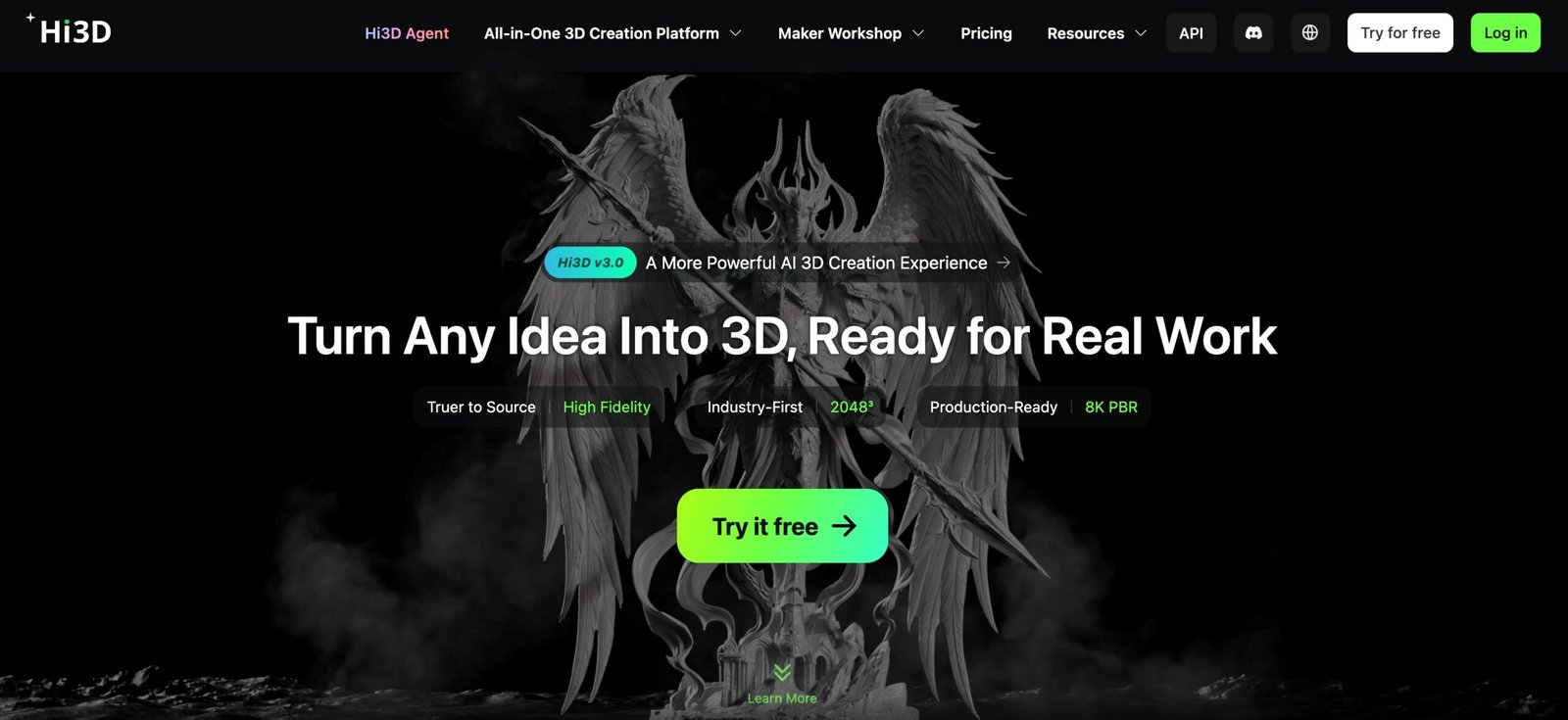
Hi3D is an AI-powered 3D creation platform developed by Math Magic. It combines image-to-3D generation with tools for visual concept creation, AI texturing, model splitting, multicolor printing preparation, and relief generation. The platform also supports multiple export formats and provides API capabilities for developers interested in integrating 3D generation into their own services.
These features make Hi3D relevant to more than individual artists. Product teams, independent brands, digital content creators, and software developers can explore how AI-generated models fit into their existing workflows. The objective is not necessarily to replace established production methods, but to make the early stages of visual development more accessible and efficient.
Exploring Product Concepts Before Investing in Production
Developing a new product often begins with incomplete information. A business may have a rough sketch, a collection of reference photographs, or a general idea of how an object should look. Before committing to detailed design work, it can be helpful to turn that idea into a three-dimensional representation.
Hi3D’s image-to-3D functionality offers a way to establish an initial model from a suitable image. Using an image to 3d model ai tool, users can provide a visual reference and generate geometry that can be examined and refined, rather than constructing every surface manually.
This approach can support early product exploration. For example, a small brand developing a decorative accessory might use a reference image to generate a preliminary model and evaluate its overall proportions. The team can then decide whether the proposed shape communicates the intended design or whether the reference needs to be revised.
Text-to-image generation provides another starting point when a concept has not yet been fully visualized. Users can describe an idea and generate images that help clarify the desired appearance before moving into three-dimensional creation. This can be useful during brainstorming, when the main objective is to explore possibilities rather than finalize a design immediately.
The distinction between concept development and engineering is important. An AI-generated model can help communicate an object’s visual direction, but it should not automatically be treated as a manufacturing specification. Precise dimensions, internal structures, material requirements, and mechanical performance may require additional CAD work and testing.
For businesses, the practical benefit is the opportunity to evaluate visual ideas earlier. By developing preliminary models before committing to detailed production, teams can identify promising directions and communicate design intentions more clearly.
Developing Visual Materials for Online Retail
Online shoppers often rely on photographs, illustrations, and product presentations to understand an item before purchasing it. Three-dimensional content can offer another way to communicate product appearance, particularly when a business wants to explore different views, surface treatments, or presentation styles.
Creating original 3D assets for every product can be expensive. AI-assisted generation may help businesses develop preliminary models from suitable reference images, giving designers a foundation for further visualization work.
Hi3D can support this process by converting product references into three-dimensional geometry. Once a suitable model has been generated, users can export it into compatible software for additional editing, rendering, or scene preparation. The resulting asset may be useful during internal reviews or as a starting point for creating more polished visual materials.
Consider an online retailer developing a collection of decorative home accessories. The design team might generate preliminary models to compare shapes and proportions before deciding which products require professional rendering. A small business could also use the models to explore alternative visual presentations without commissioning a completely new asset for every concept.
AI texturing adds another option. A model can be given different surface treatments to investigate how its appearance changes under different material or color choices. This can help a team evaluate potential product variations before creating final marketing materials.
There are important limitations. A generated model may not accurately reproduce every dimension, surface detail, or physical characteristic of the reference. Businesses should verify the result before presenting it as an exact representation of a product that customers can purchase.
For this reason, Hi3D is best viewed as a tool for visual exploration and asset preparation. Final e-commerce images and product demonstrations may still require controlled rendering, photography, or manual editing to ensure accuracy.
Supporting More Efficient Design Communication
Communication between designers, marketers, product managers, and clients can be difficult when a project is still at the concept stage. A written description may explain the intended direction, but different people can interpret the same words in different ways. A two-dimensional image helps, although it may not communicate how an object looks from every angle.
A preliminary 3D model provides another reference for discussion. Team members can examine the object’s form, identify areas that need adjustment, and communicate feedback around a shared visual representation.
Hi3D can help teams create these representations from images without requiring every participant to have advanced modeling skills. A designer can prepare a suitable reference, generate an initial model, and share the resulting asset with colleagues for evaluation in compatible software.
This can be useful when a project involves several possible design directions. Instead of discussing abstract differences between proposed shapes, a team can review tangible model outputs and identify which features best match the brief.
AI-assisted texturing can also support visual discussions. Alternative materials, colors, and artistic styles can help stakeholders understand how the same basic form might be presented in different ways. Although these variations may not represent final production materials, they can make early decisions more concrete.
The quality of communication still depends on clear expectations. Teams should distinguish between preliminary AI-generated concepts and approved designs, especially when reviewing dimensions, materials, or manufacturing feasibility.
Used in this way, Hi3D can help create a common visual reference for discussions. Its value is not limited to producing geometry; it can also help teams communicate ideas before detailed production begins.
Creating Variations Without Rebuilding Every Asset
Many businesses need multiple versions of a visual asset. A product may be offered in several colors, a digital character may require different surface styles, or a decorative object may need to fit different creative themes. Producing each variation manually can increase the amount of work involved.
AI-assisted workflows provide an opportunity to explore alternatives more efficiently. Hi3D’s image generation and texturing tools can help users investigate different appearances before deciding which versions require further refinement.
For example, a designer developing a collectible might begin with one basic concept and explore several visual treatments. Different references can help establish alternative styles, while AI texturing can be used to investigate surface appearance on suitable models.
This process is particularly useful when a team needs to compare creative directions rather than immediately produce a finalized asset. It can help identify which variations are worth developing and which are less appropriate for the intended project.
However, changing the reference image or generating a new model may also change its proportions and details. AI-generated variations should not be assumed to preserve every characteristic of the original. When consistency is important, users may need to retain a stable base model and perform more controlled editing in specialized software.
Businesses should also consider whether the variations are technically or commercially meaningful. A different texture may be sufficient for a visual concept, whereas a product that differs in dimensions or internal construction requires more substantial design work.
Hi3D can help accelerate the exploration stage, while final decisions about consistency, quality, and production suitability remain with the people responsible for the project.
Preparing Three-Dimensional Content for Different Platforms
A digital asset may need to move through several applications before it reaches its final destination. A model created for a product presentation may be edited in a 3D application, incorporated into an interactive experience, or adapted for physical production. The ability to export models into appropriate formats helps support these different requirements.
Hi3D supports common formats such as OBJ, GLB, FBX, STL, USDZ, and 3MF, depending on the feature and export workflow. Each format serves a different purpose, so users should select one according to the needs of the receiving application.
GLB is useful for many real-time visualization workflows, while OBJ is commonly used to exchange geometry and associated surface information. FBX is frequently used in animation and digital content production. USDZ supports certain augmented reality experiences, whereas STL and 3MF are relevant to 3D printing.
For businesses, this flexibility can help prevent generated assets from becoming isolated files that cannot easily be incorporated into existing production processes. A suitable model can be transferred to software for rendering, editing, or print preparation.
Nevertheless, format compatibility does not guarantee that the model will work perfectly in every environment. Texture information may need adjustment, geometry may require optimization, and the receiving application may have specific technical requirements.
Before selecting an export format, users should consider how the model will be used, which details must be preserved, and whether additional processing will be necessary. This makes it easier to establish a practical workflow around the generated asset.
Connecting Digital Design with Physical Production
Some businesses use digital models primarily for visualization, while others ultimately need to manufacture physical objects. For the latter group, AI-generated geometry can provide a starting point for exploring decorative products, display pieces, personalized items, and other suitable designs.
Hi3D supports printing-oriented workflows through compatible export formats and specialized preparation features. Users can transfer suitable models into slicing software and evaluate whether they can be manufactured with their equipment.
The platform’s model-splitting functionality can help divide certain objects into separate components. This can be useful when a model is too large to fit within a printer’s build volume or when separate parts are easier to manufacture and assemble.
Its multicolor printing workflow provides another option for suitable designs. By preparing distinct color regions for compatible printing processes, the platform can help creators explore objects that incorporate several colors.
These features may be useful for decorative products, collectible figures, and customized gifts. A business developing a small collection of display objects, for instance, can explore model designs digitally before evaluating their suitability for physical production.
However, printable geometry requires more than a convincing appearance. Wall thickness, support requirements, material properties, connector fit, and mesh integrity can all influence the final result. Users should inspect models in appropriate software and make corrections before manufacturing.
Hi3D can help bridge the initial design stage and subsequent print preparation, but the finished product still depends on the selected materials, printer, settings, and quality-control process.
Using Relief Generation for Specialized Product Ideas
Not all three-dimensional products require a complete object with depth on every side. Decorative plaques, raised illustrations, ornamental panels, and personalized keepsakes often rely on variations in surface height rather than fully developed geometry.
Hi3D’s relief-generation capability supports this type of creative work by helping transform suitable visual content into raised or recessed forms. It offers an alternative to constructing every surface detail manually and can provide a starting point for decorative designs.
For example, a small business creating personalized gifts might explore a relief based on a graphic motif or illustration. An artist could investigate how a flat image translates into a dimensional surface, while a designer might use relief generation to develop a preliminary ornamental panel.
This approach is particularly relevant when the visual structure of an image can be communicated effectively through changes in depth. Clear shapes and well-defined elements can provide useful references, although intricate designs may require additional refinement.
The resulting geometry should be checked before production. Fine features may not translate well into physical materials, and the appropriate depth depends on the manufacturing method and intended appearance.
Relief generation is therefore a specialized option rather than a replacement for conventional 3D modeling. It expands the kinds of concepts users can explore and provides another route from visual artwork to dimensional content.
Exploring API Integration for Business Applications
Businesses developing digital products may want to make 3D creation available directly within their own services. Rather than asking users to visit a separate platform, a company could investigate integrating model generation into an existing application or content workflow.
Hi3D provides API services based on Math Magic’s Sparc3D and Ultra3D technologies. These services support image-to-3D generation and specialized capabilities such as relief creation, model splitting, and multicolor model generation.
This can be relevant to software developers exploring automated visual content creation. A creative application might investigate offering image-based model generation as an additional feature, while a digital production service could evaluate whether automated geometry creation fits an existing workflow.
Different generation modes can serve different needs. A project that requires geometry alone may have different processing requirements from one that also needs textures. Selecting an appropriate mode can help developers design an integration around the intended use of the output.
API integration still requires technical planning. Teams need to consider input validation, processing time, output formats, error handling, and the quality checks required by their applications. They should also evaluate pricing, usage limits, and other current service terms before committing to a production implementation.
For businesses, the main opportunity is to assess where AI-generated 3D content can provide practical value within a larger system. Hi3D offers an option for exploring that possibility without requiring every organization to develop its own model-generation technology from the ground up.
Making AI-Assisted Design Part of a Sustainable Workflow
The value of AI-generated 3D content depends on how effectively it supports the broader objectives of a project. Producing a model quickly is useful, but the asset must also be suitable for its intended role, whether that means communicating a concept, supporting a visual presentation, or serving as a starting point for manufacturing.
Hi3D brings together image-to-3D generation, AI-assisted texturing, text-to-image creation, relief generation, model splitting, multicolor printing preparation, and multiple export options. Its API services also give developers a way to investigate automated 3D creation within their own products.
These capabilities can help businesses and independent creators explore design ideas, prepare preliminary assets, and reduce some of the repetitive work involved in early production. They do not remove the need for accurate references, technical review, or specialized editing when a project demands greater precision.
A practical approach is to identify the stages where AI can accelerate work, evaluate generated outputs carefully, and use appropriate software to address any remaining requirements. This allows automation to support creative judgment rather than replace it.
For teams looking to make three-dimensional content more accessible, Hi3D offers a flexible starting point. By connecting visual exploration with model generation and downstream production options, it can help businesses investigate new ways to develop and use digital assets across a range of creative workflows.