
Every successful production bid starts long before the first nail is hammered or the primary bill is dispatched. It starts on paper, with numbers that quietly decide whether or not an organisation wins projects or watches a competitor walk away with it. Between the earliest bid and the final bid lies a chain of estimates that both builders accept as true with a purchaser or breaks it, and knowing how they connect is what separates contractors who win continuously from those who win every so often.
How Early Numbers Shape the Whole Bidding Journey
Preliminary estimates are the difficult sketches of a project’s monetary destiny, built quickly and often before drawings are finalized. Their purpose is to answer one query early: is this challenge even really worth pursuing before real time and resources are devoted to it? An uncorrected miscalculation from a Lumber Estimator at this level can shift a bid from worthwhile to painful, and that ripple effect quietly touches each degree that follows. At this point, precision matters more than ever; the intention is actually to keep away from chasing paintings that are by no means going to pencil out.
Setting Realistic Expectations Early
Rough numbers set the tone for the whole thing that follows. If they’re wildly optimistic, each later revision appears like horrific news to the client instead of a natural refinement.
Avoiding the Trap of Underbidding
Teams that pass this stage or rush it generally tend to fix prices too early, leaving no room to absorb the surprises that usually show up as soon as real drawings arrive.
Building a Foundation for Trust
A well-reasoned initial number, even a difficult one, signals competence. Clients are aware when early figures hold up under scrutiny later in the process.
Turning Rough Numbers Into a Bid-Ready Budget
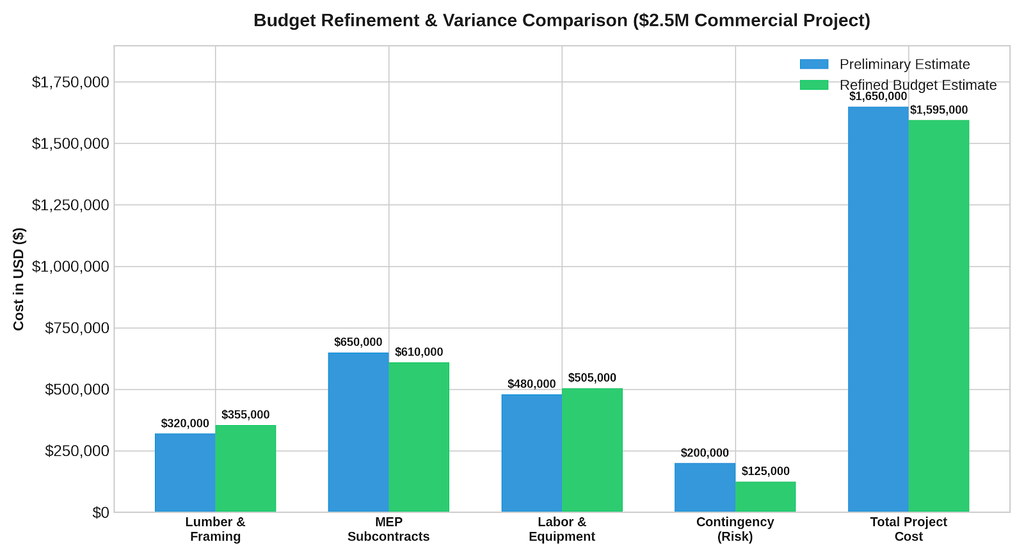
As the assignment takes shape, a Construction Estimator steps in to refine those rough numbers into something a patron can honestly agree with. This is the point wherein guesswork begins giving way to documented prices, proven rates, and realistic execution schedules. Material portions are measured more carefully, and subcontractor pricing starts to come together, turning a loose comic strip into more than a few pieces that can simply assist a bid.
| Cost Category | Preliminary Estimate | Refined Budget Estimate | Variance ($) | Variance Reason |
| Lumber & Framing | $320,000 (SF rule-of-thumb) | $355,000 (Detailed Takeoff) | +$35,000 | Structural complexity & waste factor |
| MEP Subcontracts | $650,000 (Allowance) | $610,000 (Sub Bids) | -$40,000 | Competitive submarket pricing |
| Labor & Equipment | $480,000 (Historical rate) | $505,000 (Crew Schedule) | +$25,000 | Site accessibility & crane rental |
| Contingency (Risk) | $200,000 (10% Flat) | $125,000 (Itemized Risk) | -$75,000 | Reduced design ambiguity |
| Total Project Cost | $1,650,000 | $1,595,000 | -$55,000 | Tighter, defensible cost baseline |
Locking In Material and Labor Costs
This is where portions get counted, not guessed, and where charges from suppliers begin changing assumptions from a previous undertaking.
Where Contingency Planning Fits In
A smart price range usually leaves room. Skipping this step is one of the quickest ways to turn a “prevailing” bid right into a dropping project.
Bridging the Gap Between Budget and Bid
The financial estimate is the last checkpoint before numbers go public. Anything ignored here turns into a legal responsibility the moment the bid is submitted.
The Moment a Budget Becomes a Winning Bid
A bid is more than a variety of options on a web page; it is a promise, telling a client exactly what they will get, when they may get it, and what it’s going to cost. Many contractors reach this stage and understand they need outside eyes on the numbers, and bringing in expert Construction Estimating Services at this point can catch mistakes that get buried in a rushed in-house calculation. It often uncovers financial savings that weren’t apparent the first time around, and a 2d, experienced set of eyes hardly ever hurts.

Reading Between the Lines of a Client’s RFP
The nice bids solution questions the client failed to explicitly ask. Understanding what a consumer truly values, beyond the lowest price, frequently comes to a decision the outcome.
Pricing Competitively Without Underselling Value
There’s a difference between a competitive fee and a desperate one. Clients can usually tell which is which, and it influences how much they trust the rest of the proposal
Presenting Numbers That Build Confidence
A clean, nicely organized bid record is more convincing than human beings assume. Clarity itself turns into a selling point.
Common Mistakes That Sink a Bid
Even skilled contractors fall into predictable traps that quietly erode a bid’s possibilities. Most of them point again to the identical root cause: treating an early number as fixed in place of something that desires to keep evolving along the project.
- Treating the initial estimate as final in preference to a starting point that needs refinement.
- Underestimating the productivity of effort on complex or unusual undertaking kinds.
- Failing to account for cost volatility between bidding and real purchase.
Choosing the Right Approach for Your Next Project
Not every mission calls for the same degree of estimating effort, and forcing a one-size-fits-all manner onto each activity is its own type of hazard. The right method generally comes down to three deliberate decisions made early as opposed to left to chance.

- Match the extent of estimating element to the size and threat of the challenge instead of the use of a one-size-fits-all system.
- Decide early whether in-residence sources are enough or whether the mission’s complexity calls for outdoor understanding.
- Revisit and adjust the numbers as drawings evolve, rather than treating any unmarried estimate as everlasting.
Final Thoughts
The journey from a hard first wager to a signed settlement is sincerely a tale of growing precision, and every stage along the manner both strengthens or weakens the one that follows. Contractors who deal with these estimates as a related technique, instead of isolated paperwork duties, continually post stronger, more defensible bids. Small errors made early tend to multiply by the point an undertaking reaches execution; at the same time, time and know-how invested in advance almost always cost much less than solving problems after a bid is won.
FAQs
1. What’s the main distinction between a preliminary estimate and a price range estimate?
A preliminary estimate is a rough, early-level estimate used to decide whether or not a mission is really worth pursuing, whereas a price range estimate is a more subtle variation based on firmer quantities, hard work schedules, and pricing.
2. Why do initial estimates rely on them if they’re not correct?
They do not want to be flawlessly correct; they need to be directionally correct. Their job is to filter out projects that don’t make financial sense earlier than any actual time is invested.
3. How much can a poorly achieved estimate affect a final bid?
Quite a bit. Errors made at the preliminary or price range stage tend to compound, and by the time a bid is submitted, a small early mistake can turn into a great loss of income.
4. When must a contractor call in outside assistance for estimating?
Most contractors benefit from outside information once a project grows complex, includes surprising substances or scopes, or when internal teams are stretched too thin to double-check every variety.
5. Does a lower bid usually win the undertaking?
Not continually. Clients often weigh reliability, clarity, and performance alongside fee, particularly when a bid appears strangely low in comparison to competition.