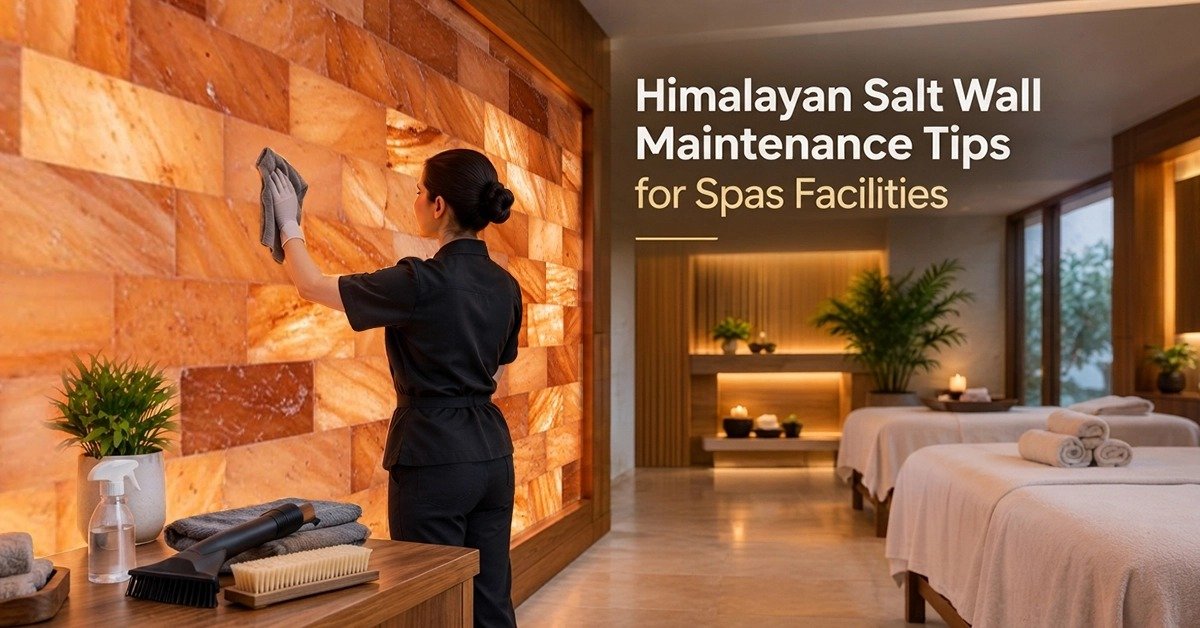
A Himalayan salt wall maintenance checklist should include keeping salt bricks dry, controlling humidity, removing dust safely, inspecting bricks and joints, checking LED lighting, maintaining ventilation, and correcting moisture problems quickly.
For spas and wellness centers, staff should check the wall regularly because water, condensation, high humidity, cleaning activities, and physical impact can gradually damage natural salt bricks.
Himalayan Salt Wall Maintenance Checklist
Check out this checklist of how to successfully maintain a commercial wall! Set the time based on room conditions, frequency of traffic, humidity, drying rate, usage plan, and manufacturer guidelines.
1. Keep Himalayan Salt Bricks Dry
An important maintenance tip is to make sure the salt bricks are dry. In general, the top priority when it comes to maintenance is to keep the bricks dry because Himalayan salt is hygroscopic, which means that it attracts moisture. Water is corrosive to salts to some extent. Prevent the wall from leaks, condensation, splashing water, and excessive steam as well.
Check regularly for:
- Plumbing leaks
- Water splashes
- Condensation
- Ceiling leaks
- Steam exposure
- Water near the wall base
If moisture repeatedly appears, identify and correct the source.
2. Monitor Humidity and Ventilation
A commercial wall needs moderation of humidity as well. There is no one-size-fits-all level of humidity for every installation, so stick to that required by the manufacturer. In some installations, the moisture development can be restricted by keeping the relative humidity below approx. 35%–55% RH.
Use a reliable hygrometer and maintain adequate airflow.
Recommended checks:
- Record humidity readings.
- Check ventilation performance.
- Watch for condensation.
- Use dehumidification when appropriate.
- Keep water sources away from salt bricks.
3. Clean the Salt Wall Using Dry Methods
Regular cleanings, which adds in removing dust but without humidity. You can use soft microfiber cloths, a gentle brush or and an appropriate vacuum-brush attachment. Do not soak, pressure wash, or spray bricks.
Simple cleaning process:
- Allow lighting components to cool when required.
- Gently remove surface dust.
- Clean edges and joints carefully.
- Use low-suction vacuuming where appropriate.
- Follow manufacturer cleaning instructions.
4. Inspect Bricks, Joints, and Wall Support
You can avoid the spread of issues through regular checks. Explore for physical or moisture-related deterioration of the salt bricks, joints together with backing in addition to supporting domains.
Look for:
- Cracked bricks
- Chipped edges
- Loose bricks
- Crumbling areas
- Open or deteriorating joints
- Unusual movement
- Surface changes
- Moisture residue
A loose or structurally affected section should be assessed by a qualified professional.
5. Check LED Salt Wall Lighting
Salt wall kits often feature hidden LED lighting for a soft pink, amber or orange glow. Inspect the system routinely for flicker, dark areas in excessively hot wiring or hard to reach service access points.
For a warm decorative appearance, 2700K–3000K LEDs are commonly suitable.
Check:
- Even illumination.
- Failed LEDs
- Flickering
- Excessive heat
- Accessible connections
- Service access
Electrical work should be completed by qualified personnel where required.
6. Protect the Wall During Spa Cleaning
Cleaning procedures can create unnecessary moisture exposure if staff treat bricks like ordinary tile. Include salt-wall protection in the facility’s cleaning policy.
Staff should:
- Avoid spraying cleaners toward the wall.
- Keep wet mops away from bricks.
- Prevent water pooling.
- Avoid pressure washing.
- Avoid steam cleaning the salt.
- Report moisture or damage immediately.
Staff training is one of the simplest ways to prevent avoidable salt-wall damage.
7. Identify Moisture Damage Early
Any signs of moisture problems should be investigated immediately. They may also be visible signs of condensation, white crystalline residues on the surface or softening, color change that can range from yellow to black, crumbling edges and greater cracking.
Salt comes from the natural surroundings and leaves white residue when moisture dissolves it before heading back into a crystal form.
Investigate:
- Humidity
- Condensation
- Ventilation
- Plumbing leaks
- Direct water exposure
- Nearby cleaning activities
Correct the moisture source instead of repeatedly removing the visible residue.
8. Maintain a Commercial Inspection Log
Using a maintenance log helps spa managers and facility teams observe the status of their wall as well as any recurring issues. Inspections performed, levels of humidity detected, damage caused to the home (any moisture problems if found), and lighting conditions are maintained within place as well as wherever repairs are completed.
| Inspection item | Information to record |
| Date | Inspection date |
| Humidity | Relative humidity |
| Surface | Dust, residue, discoloration |
| Bricks | Cracks, chips, loose sections |
| Joints | Condition |
| Lighting | Working condition |
| Moisture | Leaks or condensation |
| Ventilation | Airflow concerns |
| Action | Repair or follow-up |
| Inspector | Staff member |
Dated photographs can provide additional condition records. Maintenance guidance reviewed by the Pink Salt Wall team based on salt-wall installation practices, product specifications, and manufacturer recommendations.
Common Himalayan Salt Wall Maintenance Mistakes
Avoid these mistakes to reduce unnecessary deterioration and repair requirements:
- Using excessive water
- Spraying cleaners directly onto salt
- Ignoring high humidity
- Leaving leaks unresolved
- Aggressively scrubbing bricks
- Ignoring loose or cracked bricks
- Blocking ventilation
- Allowing water to pool near the wall
- Using unapproved cleaning products
- Performing electrical repairs without proper qualifications
Proper installation is the foundation of long-term performance, so review our guide on Himalayan Salt Wall Installation Mistakes & How to Avoid Them to reduce future maintenance requirements.
Expert Maintenance Schedule for Spas and Wellness Centers
A simple schedule makes salt-wall maintenance easier for staff to follow. Pink salt wall team recommended following steps to maintain the wall to regulate long term results in spas and wellness centers.
Daily
- Check for moisture, condensation, or visible damage.
Weekly
- Remove dust using dry methods.
- Check humidity and surrounding areas.
Monthly
- Inspect bricks, joints, ventilation, and lighting.
Every 3–6 months
- Complete a detailed condition inspection.
Immediately
- Investigate leaks, persistent moisture, major cracks, loose sections, or electrical problems.
| Frequency | Maintenance task | What to check |
| Daily | Visual inspection | Moisture, condensation, residue |
| Weekly | Dry cleaning | Dust, edges, joints |
| Weekly | Environment check | Humidity and ventilation |
| Monthly | Brick inspection | Cracks, chips, loose bricks |
| Monthly | Lighting check | LEDs, heat, illumination |
| Every 3–6 months | Detailed inspection | Joints, support, deterioration |
| As needed | Corrective repair | Moisture or physical damage |
| Annually | Professional review | Installation condition |
Conclusion
To maintain Himalayan salt walls effectively, ensure that salt bricks stay dry, humidity is regulated, clean with care, check bricks and joints, maintain proper ventilation and lighting. When executing preventive maintenance, spa and wellness-center teams ought to immediately try investigating moisture and record maintenance activities.
Having a regular inspection schedule allows visible degradation to be flagged early as well as preserving the appearance of the wall to ensure avoidable repairs are avoided and aiding safe long-life operation of the commercial installation.
Contractors can explore Pink Salt Wall’s pre-configured Himalayan salt wall kits for commercial projects, with coordinated bricks, adhesive, and LED lighting
Frequently Asked Questions
Can you clean a salt wall with water?
No, because it can dissolve salt. Follow the manufacturer’s specific cleaning instructions.
What humidity is best for a Himalayan salt wall?
Follow the manufacturer’s specification. Below approximately 35%–55% RH may be suitable for some installations, but it is not a universal requirement.
What causes white residue on a salt wall?
Moisture can dissolve salt at the surface and cause it to recrystallize as white residue.
Can damaged Himalayan salt bricks be replaced?
Individual bricks may be replaceable depending on the installation system. Follow the original installation method and manufacturer requirements.
How often should a Himalayan salt wall be inspected?
Visually inspect the wall regularly, with more detailed inspections based on humidity, water exposure, traffic, installation conditions and manufacturer recommendations.
How do you prevent moisture damage to a Himalayan salt wall?
Prevent direct water exposure, monitor humidity, maintain adequate ventilation, address leaks and condensation quickly, and follow the manufacturer’s environmental and maintenance requirements.